- November 18, 2025
- Metal Buildings
- Carports Advisor
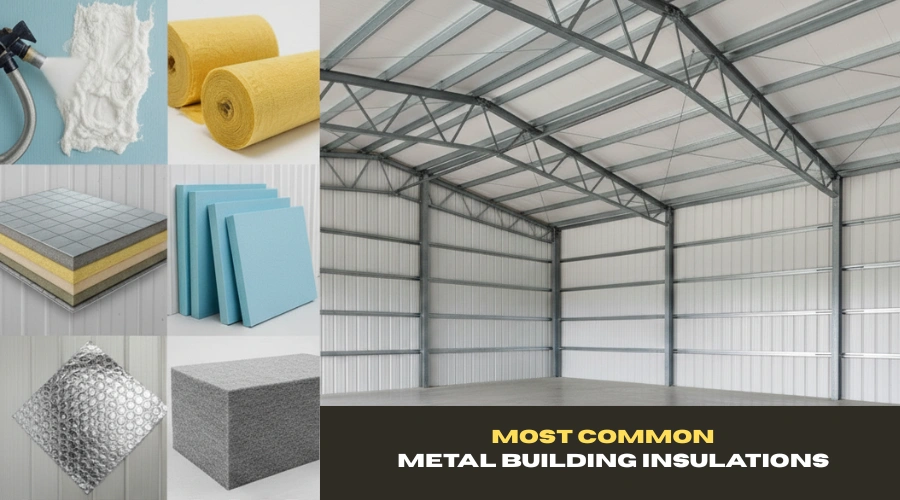
A Breakdown Of The Most Common Metal Building Insulations
Most people who are installing a new metal building remain confused about what type of insulation they should choose, what part they must insulate, and what common options are available in the market. After all, every home, farm, and business owners want their steel structure to last long, so they make the most of it.
Common Insulation Types For Metal Buildings: R-Value, Installation & Uses
Here are some of the commonly used insulators in a metal structure for homes, farms, and commercial spaces. We will be discussing its R-value, installation Method, its use case, and potential uses:
1. Fiberglass Blanket [Batts And Rolls]
It is made of flexible glass fibers, which are spun into a wool-like material that offers excellent thermal resistance and traps air. Fiberglass insulation may come with or without facings like Kraft paper, foil, or vinyl, which act as vapor barriers.
1.1 Its R-Value
- R-11 to R-18 (depending on density and thickness)
- High density R-3.7 to R-4.3 per inch
Note: The standard thickness of a fiberglass insulator is 3.5 to 12 inches.
1.2 Its Benefits
- Lightweight
- Easy to install
- Cost-effective
- Customizable [range of R-values]
- Fire resistance
- Sound dampening
- Reduce heating and cooling costs
1.3 Its Use Case
- Home (living space) – used in walls, roof, and ceiling of metal building homes for thermal comfort and sound dampening.
- Home (non-occupant space) – used in metal garages and steel workshops to regulate temperature, reduce condensation, and make space comfortable to pursue hobbies.
- Farm Barns – used in livestock barns to control temperature, stored feeds and hay bales, and for moisture resistance.
- Business – used in walls and roofs of metal commercial buildings, especially when budget is a primary concern.
2. Spray Foam Insulation [Polyurethane]
It is made using two chemical mixtures that expand upon application and form a rigid, airtight barrier. Its materials are made up of polyurethane, blowing agents, and catalysts or surfactants.
2.1 Its R-Value
- Closed Cell: R-6 to R-7 per inch
- Open Cell: R-3.5 to R-4 per inch
- Thickness: 1 to 6 inches
2.2 Its Benefits
- Superior thermal resistance
- Air sealing
- Moisture and condensation control
- Seamless application
- Air and moisture barrier
- Noise reduction
- Durable
- Reduce heating and cooling costs
2.3 Its Use Case
- Home (living space) – best for a tight building envelope in metal homes.
- Home (non-occupant space) – best for insulated irregular shape corners and cavities.
- Farm Barns – used to provide shelter for livestock sensitive to temperature fluctuations.
- Business – used in complex design to provide superior insulation and air barrier.
3. Rigid Board Insulation [Foam Boards]
It is made using foam-based material that gives higher thermal resistance and durability, such as:
- Polystyrene (EPS | XPS): lightweight, moisture-resistant foam.
- Polyisocyanurate (Polyiso): high-performance foam with foil facings.
- Polyurethane: dense, durable foam.
3.1 Its R-Value
- Polystyrene: R-3.6 to R-5 per inch
- Polyiso: R-5.6 to R-7 per inch
- Polyurethane: R-6 to R-7 per inch
- Thickness: 1 to 6 inches, depending on insulation needs
3.2 Its Benefits
- Adds rigidity to metal panels
- Fire resistance
- Moisture barrier
- Higher durability
- Less maintenance
- Easy to install
- Dampens noise
3.3 Its Use Case
- Home (living space) – used as continuous insulation on the exterior/ interior of a metal tiny home to improve energy efficiency.
- Home (non-occupant space) – suitable for insulating walls and roof of a metal outdoor shed, steel garage, or a personal workshop, as it is easy to handle in large and flat areas.
- Farm Barns – used for metal agricultural barns as it is durable and resistant to moisture and pests.
- Business – used for continuous insulation in commercial steel buildings to meet energy codes and for better thermal performance.
4. Insulated Metal Panels [IMPs]
It has an insulation core sandwiched between two durable metal sheets, which offer superior thermal efficiency and a modern, sleek appeal. It comes at a high initial cost but eliminates the need to separate insulation installation. IMPs are made using:
- Polyisocyanurate (Polyiso) or Polyurethane foam core (for insulation)
- Steel | Aluminum exterior
- Protective coatings
4.1 Its R-Value
- R-5 to R8 per inch (depends on core material)
- Thickness: 2 to 6 inches (high-density option is available)
4.2 Its Benefits
- Aesthetic appeal (comes in various finishes)
- Moisture and air barrier
- Structural strength
- Quick installation
- Fire resistance
4.3 Its Use Case
- Home (living space) – less common in metal barndominiums.
- Home (non-occupant space) – used for its quick and efficient insulation and finishing the interior and exterior of metal garages and workshops.
- Farm Barns – used in livestock barns as IMPs are easy to clean.
- Business – very popular in industrial steel structures due to high insulation value, fast installation, and aesthetic options.
5. Reflective Insulation [Radiant Barriers, Woven R17, Single & Double Bubble]
It is made using the following, which reduces heat transfer in metal buildings by reflecting radiant heat (instead of absorbing):
- Aluminum foil layers (to reflect radiant heat)
- Polyethylene bubbles (single/ double bubble)
- Woven fabric layers (durability and insulation value)
At Carports Advisor, we offer affordable single and double bubble insulators and woven R-17 for higher thermal efficiency. You can create your own steel building design using our 3D designer tool, choose a custom size, roof, pitch, and insulation choices.
5.1 Its R-Value
- Single Bubble: R-1 to R-3 (thickness: 3/16 to ¼ inches)
- Double Bubble: R-3 to R-6 (thickness: ¼ to ½ inches)
- Woven: R-17 (thickness: 5 mm or 0.4 inches)
5.2 Its Benefits
- Condensation control
- Easy to install
- Cost-effective
- Reduce heat gain in summer and heat loss in winter
- Moisture barrier
- Lightweight and flexible
5.3 Its Use Case
- Home (living space) – good for warmer climates in attics and occasionally in walls to reduce cooling costs.
- Home (non-occupant space) – use in garages or workspace to reduce heat gain in a hot climate and make indoor useable.
- Farm Barns – used to keep animals cool and reduce intense UV heating during summers.
- Business – used for effective reflective heating in commercial metal structures in roofs to reduce heating from the sun and lower energy bills.
For example, a 42×72 all vertical steel building with a height of 12 ft. comes with R-16 Produx insulation, which offers mold and mildew resistant and has superior thermal protection.
6. Mineral Wool [Rock Wool | Slag Wool]
It is made using the following materials:
- Rock Wool (basalt rock) or slag wool (industrial slag) is melted and spun into fibers
- Binder agent (that holds fiber together)
- Water repellent additives (for moisture resistance)
6.1 Its R-Value
- R-3.7 to R-4.3 per inch
- Thickness: 1 to 6 inches (depending on insulation needs)
6.2 Its Benefits
- Fire resistance (can withstand temperatures over 2000 ℉)
- Naturally hydrophobic (prevents water absorption)
- Reduce noise transmission in metal structures
- Don’t need chemical fire retardants
- Easy to install
- Available in batts, boards, and loose-fill
- Sustainable and eco-friendly choice
- Reduce heating and cooling costs
6.3 Its Use Case
- Home (living space) – used in walls, roofs, and ceilings for metal Barndo as it gives ideal thermal and acoustic properties, along with fire resistance.
- Home (non-occupant space) – used for sound dampening and fire resistance.
- Farm Barns – used in farm barns for its fire-resistant properties and ability to provide ample thermal insulation.
- Business – used in walls and roof assemblies of metal panels of a commercial structure.
What Part Of The Steel Building Should You Insulate?
I. Necessary Parts Of The Building That You Must Insulate:
1. Metal Roof Panels
Heat Loss: about 25%
That’s right! About 25% of the total heat is lost via the roof [source: heatsquad.org]. So, an insulating roof is crucial to prevent heat gain in summer and heat loss in winter generated by the boiler, furnace, and other heat sources.
2. Side And End Wall Panels
Heat Loss: about 35%
Insulating walls helps reduce thermal transfer and improves indoor comfort. Walls, along with gaps around the doors and windows’ frames, can contribute to about 35% of the heat loss from a structure.
II. Optional Parts Of The Building That You Can Insulate:
3. Floors
Heat Loss: about 10%
In extreme climates, an insulating floor can reduce heat loss in cold regions or reduce moisture in humid areas.
4. Windows And Doors
Insulated windows and door panels prevent air leaks, reduce condensation and drafts, and improve energy efficiency.
5. Gaps And Joints
Filling up small cracks, gaps, and holes in corners, edges, and along joints will improve overall insulation performance and enhance structural integrity.
Which Insulation Should You Choose For Your Metal Building?
Here is a general breakdown of insulation needs across various states in our country. You can learn about the exact R-value by consulting your local municipal department or determining it based on the use of the building.
- Cold Climate (Higher R-value is necessary to reduce heating costs): Minnesota, Wisconsin, North Dakota, Montana, New York, Pennsylvania, Maine.
- Hot And Humid Areas (moisture control is necessary to regulate indoor temperature): Florida, Texas, Louisiana, Southeast areas (like Georgia, Alabama, Mississippi)
- Moderate Climatic Regions (balanced insulation is necessary for year-round comfort): California, Oregon, Washington, and the Midwest regions (like Illinois, Ohio, Missouri)
Choose The Right Insulation For Your Steel Building Today!
No matter whether it is the carport, garage, barn, or a commercial steel building, insulation is a must to ensure longevity, reduce heat transfer and noise, and make the indoor space comfortable for work, livestock, storage, or business. If you are looking for a metal garage or building with insulation options, call us at (336)-914-1654 today. Our metal building experts will guide you to the best designs that fit your purpose and budget.
 (336)-914-1654