- April 28, 2026
- Metal Buildings
- Carports Advisor
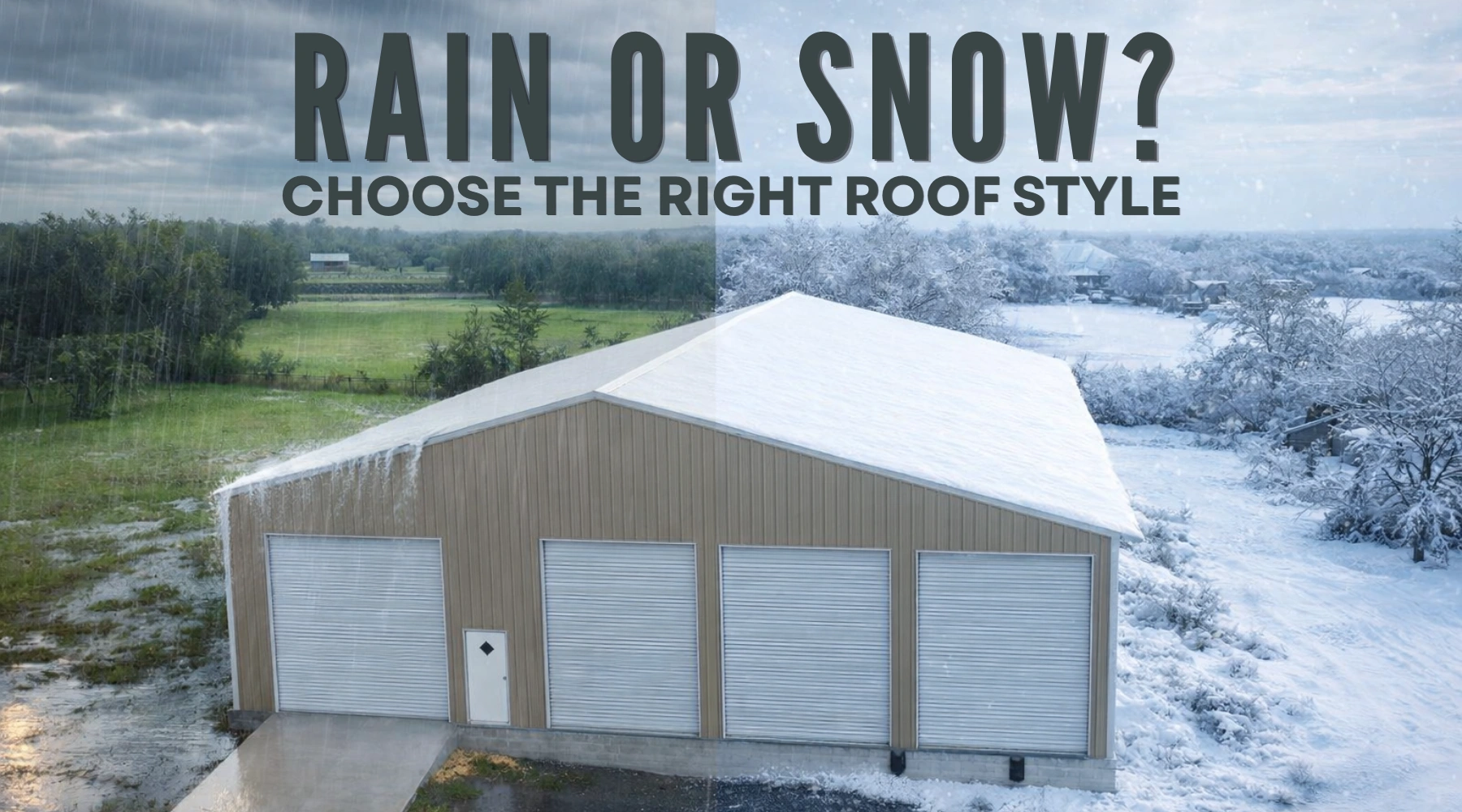
Choosing The Right Roof Style for Rainy vs Snowy Regions
The roof style on your metal building does more work than most people realize, and getting it wrong costs more than getting it right.
When most people order a metal building, they spend a lot of time thinking about size, doors, and color. Roof style usually gets picked last, sometimes almost as an afterthought. That’s a mistake that shows up two, five, or ten years later in the form of rust at panel seams, pooling water, or worse, a roof struggling under snow load it was never engineered to handle.
The roof style you choose behaves very differently depending on where you live. A roof that performs fine in the mild, dry climate of central Texas will underperform in the persistent rain of Oregon and can become a genuine liability under the wet, heavy snow of a Colorado winter. Understanding why that happens, and which roof style matches your region,is what this guide is about.
The Three Metal Building Roof Styles – What Makes Each One Different
1. Regular Style Roof
The regular metal garage is the entry-level option. It has rounded corners where the roof meets the legs and uses horizontal panels that run the length of the building. It’s the lowest price point and it works in mild, dry climates where rain and snow are infrequent. The limitation is structural: horizontal panels create seams where water can pool and sit rather than running off cleanly. In regions with consistent weather, that pooling is where rust begins, and it begins earlier than most buyers expect.
2. Boxed Eave Roof
The boxed eave metal garage has squared corners and a cleaner visual profile than the regular style — it looks more like a traditional building and costs a little more. But underneath the improved appearance, the panel orientation is still horizontal. That means it carries the same fundamental weakness in wet or snowy climates. A boxed eave metal garage is a meaningful upgrade in appearance and a marginal upgrade in weather performance. In truly challenging climates, that distinction matters.
3. Vertical Roof
The vertical metal garage runs its panels perpendicular to the ground — from the ridge straight down to the eave — rather than horizontally along the length of the building. This single difference in panel direction changes how the roof handles weather entirely. Rain channels straight down the panels and off the building. Snow slides off before it accumulates to a dangerous weight. Seams run vertically, so water never has a horizontal gap to collect in. It’s the roof most professional builders specify by default, and for most of the country, it’s the correct choice.
Roof Performance in Rainy Regions
How Rain Behaves on Horizontal vs. Vertical Panels
On a horizontal panel roof, rain hits the surface and runs toward the seams between panels. Those seams are where water collects, where dirt accumulates, and where the protective coating works hardest. Over time — particularly on wide-span buildings where the roof pitch is relatively shallow — horizontal seams become the first place rust appears. On a vertical roof metal carport or building, panels channel water directly downward with no horizontal seam to interrupt the flow. The roof sheds rain the way it’s supposed to: efficiently, completely, and without creating the conditions where long-term damage begins.
High-Rainfall States Where Roof Style Really Matters
- Pacific Northwest (Oregon, Washington): year-round rainfall with significant annual precipitation totals and persistent humidity that accelerates corrosion at unprotected seams
- Southeast (Alabama, Georgia, Mississippi, Florida): heavy seasonal rain, high humidity, and in coastal areas, salt air that compounds the corrosion problem on any horizontal seam
- Gulf Coast: some of the highest rainfall volumes in the country, combined with salt air — a combination that shortens the lifespan of a horizontal roof faster than almost any other climate
The Best Roof Style for Rainy Regions
A vertical roof is the clear answer for any region with consistent rainfall. A boxed eave roof looks better than a regular style, but it still uses horizontal panels — and in a wet climate, that means it still underperforms over a 10 to 15-year horizon. The vertical roof paired with quality panel coatings, gutters on a large building, and proper site drainage gives you a structure that handles rain year after year without creating the incremental damage that starts silently and shows up expensively.
Rain is one challenge. Snow is a completely different one — and it demands even more from your roof structure.
Roof Performance in Snowy Regions — When Weight Becomes the Problem
Why Snow Is a Structural Issue, Not Just a Weather Issue
Rain runs off a roof. Snow sits on it. That distinction is what makes snow a structural concern rather than just a weather concern. Wet, dense snow — the kind common in mountain states and the Great Lakes region — can weigh up to 20 pounds per cubic foot. On a 40-foot-wide building with even a modest accumulation, that weight adds up to thousands of pounds pressing down on the roof structure. A barn roof collapse warning sign is almost always preceded by exactly this kind of slow, heavy accumulation on a roof that wasn’t engineered to carry it.
Horizontal panels compound the problem. Instead of shedding snow as it falls, they create a flat surface for it to pile on. Ice dams form at the seams as snow melts and refreezes. The combination of weight, ice expansion, and seam stress is what causes structural failures in under-spec buildings during serious winter weather.
High-Snowfall States Where the Wrong Roof Fails
- Mountain West (Colorado, Montana, Wyoming): heavy, wet snow accumulation across extended winters with some of the highest snow load requirements in the country
- Great Lakes (Michigan, Wisconsin, Minnesota): lake-effect snow events that can drop multiple feet of snow in a short period, creating rapid load accumulation
- Northeast (New York, Pennsylvania, Vermont): prolonged winter snow loads combined with freeze-thaw cycles that stress horizontal seams repeatedly across a long season
The Best Roof Style for Snowy Regions
A vertical roof is the only practical choice for serious snow regions. Vertical panels shed snow as it accumulates rather than holding it flat on the surface. That shedding isn’t just a performance benefit — it’s a safety one. RV covers in high wind zones and snowy climates rely on this same principle: panels that actively move weather off the structure rather than letting it build up.
Beyond roof style, snow regions demand additional engineering. A snow load upgrade adjusts the structural specification of the building — the framing, the gauge of steel, and the connection points — to carry the certified weight your region requires. Upgrading from 14-gauge to 12-gauge steel framing adds meaningful structural resilience and is worth the cost in any region where heavy snow is a seasonal reality.
What if your region gets both heavy rain and heavy snow? Here’s how to think about that.
What If You Get Both Rain and Snow? (Mixed Climate Regions)
1. States That Deal With Both Extremes
Some regions don’t choose between rain and snow — they deal with both in the same year, sometimes in the same month. Pennsylvania gets significant snowfall through winter and then sustained spring rainfall. Ohio and Michigan experience lake-effect snow alongside wet springs and humid summers. Oregon’s western valleys get heavy year-round rain with occasional snow events that can be surprisingly heavy when they do arrive. These mixed-climate regions need the most robust roof specification of all because the building faces multiple failure modes across twelve months.
2. The Right Specification for Mixed Climates
Vertical roof is the non-negotiable starting point — it handles both rain and snow better than any alternative. Pair it with 12-gauge steel framing for structural resilience across both seasonal challenges. A combined wind and snow load engineering certification ensures the building is stamped for the actual conditions in your county, not just a baseline national standard. Quality sealants and closure strips at all panel joints seal the roof against both water intrusion in wet seasons and ice expansion in cold ones. This is the specification that builds a structure meant to last decades in a climate that tests it every year.
Roof Style by Region — Quick Reference Guide
Use this table to match your region to the right roof specification. Note that vertical roof is the right answer for most of the country — the exceptions are the driest, mildest regions where weather demands are genuinely low.
|
Region |
Climate Challenge |
Recommended Roof |
Key Upgrade |
| Pacific Northwest | Year-round rain | Vertical | Gutters + drainage |
| Southeast / Gulf Coast | Heavy rain + humidity | Vertical | Quality coating + gutters |
| Mountain West | Heavy wet snow | Vertical | Snow load engineering |
| Great Lakes | Lake-effect snow | Vertical | 12-gauge + snow load |
| Northeast | Snow + ice + rain | Vertical | Full engineering package |
| Midwest Plains | Wind + moderate snow | Vertical or Boxed Eave | Wind load upgrade |
| Southwest / Southern Plains | Dry + mild | Regular or Boxed Eave | Basic — standard spec |
The Cost Difference – Is Vertical Roof Worth the Extra Money?
What Vertical Roof Actually Costs More
The price premium for a vertical roof over a regular-style roof typically runs $500 to $1,500, depending on the size of the building. On a 40×60 metal building, that’s a small fraction of the total project cost. What you get for that premium is a roof that performs better from day one, maintains its integrity longer in challenging weather, and requires less maintenance intervention over its service life.
The Real Cost of Getting It Wrong
Rust repair and panel replacement on a horizontal roof after five to eight years in a wet climate typically costs $2,000 to $6,000, depending on how much of the roof surface has been affected. Structural repair after snow load damage on an under-spec building can exceed the original cost of the building itself. Insurance implications of a roof failure on stored equipment, vehicles, or livestock add another layer of financial exposure that a correct roof specification eliminates entirely.
The $500 to $1,500 difference between a standard roof and a vertical roof is the smallest cost in a building project and the one with the highest long-term impact on what that building actually costs you over its lifetime.
Top Questions From Buyers About Roof Styles and Climate
1. Does a regular roof work in Florida?
Only in the driest inland areas, and even there, a vertical roof is a better long-term choice. Florida’s combination of high rainfall, humidity, and coastal salt air is one of the most demanding environments for any horizontal panel roof. The regular metal garage is priced attractively, but in Florida’s climate, the long-term maintenance cost closes that gap quickly.
2. Is a vertical roof required for a Colorado building?
Not legally required in every county, but practically essential. Colorado’s wet, heavy snow loads are exactly the conditions that horizontal panel roofs struggle with most. Most experienced metal building suppliers in Colorado won’t quote a horizontal roof for a serious building without flagging the risk.
3. Can I upgrade from a regular to a vertical roof later?
No — and this is one of the most important things to know before you order. Changing roof style requires complete re-paneling of the structure. The panel attachment points, the ridge cap, and the closure strips are all different. Decide on a vertical roof before you order, not after you’ve lived with the wrong one for three years.
4. Does roof style affect my building warranty?
Yes. Some manufacturers apply warranty conditions based on roof style in certain regions. A regular or boxed eave roof installed in a high-rainfall or high-snow area may carry a reduced or voided warranty for weather-related damage. Always read the warranty terms alongside the roof style specification.
5. What’s the difference between a vertical roof and a Quonset hut style?
A Quonset hut is a fully curved structure — the walls and roof are one continuous arc. A vertical roof metal building has straight walls and a peaked or gabled roof with vertical panels on the roof surface only. They’re both effective in challenging climates, but they’re entirely different structures with different use cases, interior configurations, and cost profiles.
Long Story Short
For most of the country — anywhere with meaningful rain, snow, or both — a vertical roof is the correct specification, not a premium upgrade. The three roof styles are not interchangeable options where you pick the one that fits your budget. They perform differently, and those performance differences are most visible in the exact climates where most people are building: the rainy Pacific Northwest, the snowy Mountain West, the humid Southeast, and the mixed-climate Northeast and Midwest.
Know your climate. Match your roof style to the actual weather conditions your building will face across its lifetime. The $500 to $1,500 difference between a standard roof and a vertical roof is a rounding error in any serious building project.
 (336)-914-1654