- May 12, 2026
- Metal Buildings
- Carports Advisor
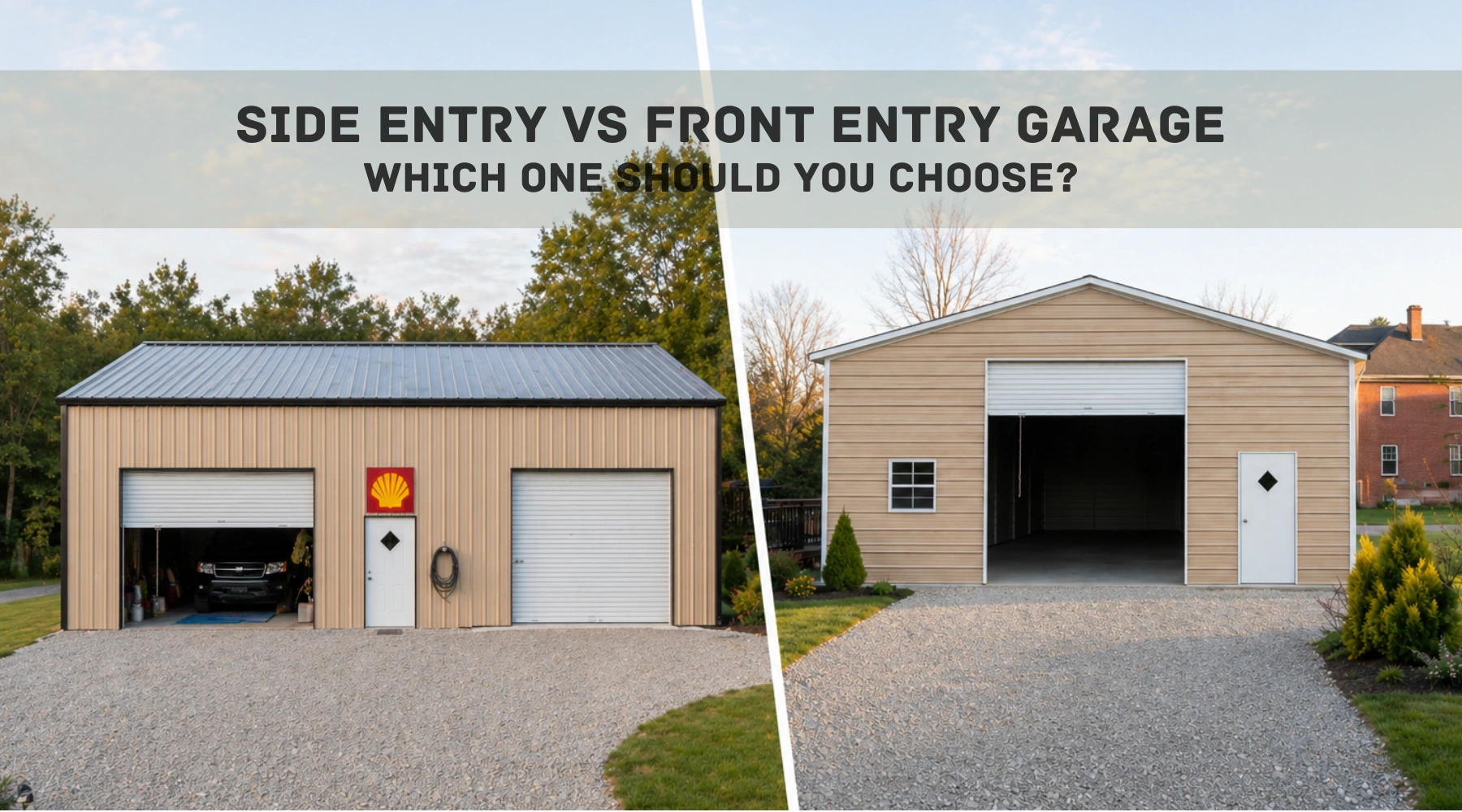
Side Entry vs Front Entry Garage: Which One Should You Choose?
You might not think much about your garage until you actually have to design one. But the moment you start planning, one question shows up and refuses to go away. Should you go with a side entry or a front entry garage?
At first, it feels like a small design choice. But this decision affects how your home looks from the outside, how easily you can park every day, and even how much value your property holds in the future. Some homeowners love the clean look of a side entry garage in front of house layouts, while others prefer the simplicity and convenience of a front-facing design.
The truth is, there is no one-size-fits-all answer. The right option depends on your space, your lifestyle, and how you want your home to feel. Let’s break it down step by step so you can make the right choice without second-guessing later.
What is A Front Entry Garage?
A front entry garage is the most common style in the USA. It is simple, practical, and works well for most standard homes.
In this design, the garage door faces the street, making access quick and direct. It is especially useful for homes with limited space or smaller plots.
Front entry garage advantages include easy driveway design and lower construction complexity. If you want to understand structural options, you can explore an attached and detached garage.
What is A Side Entry Garage?
A side entry garage is designed with the garage door facing the side of the house instead of the street. It is often seen in modern or premium home designs.
This layout improves curb appeal by keeping the front of the house clean and less crowded. Side entry metal garages in front of house setups often require a wider lot and proper turning space.
The placement of the side entry garage door also affects how you design your driveway. So, you must be careful before you choose a side entry garage because it further affects the curb appeal of your home.
Key Differences Between Side Entry and Front Entry Garages
Before going deeper, it helps to quickly compare both options side by side. This gives you a clear understanding of how they differ in real life.
| Feature | Front Entry Garage | Side Entry Garage |
|---|---|---|
| Garage Door Facing | Street | Side of the house |
| Space Requirement | Less | More |
| Curb Appeal | Moderate | High |
| Driveway Design | Simple | Requires turning space |
| Cost | Lower | Higher |
The side entry vs front entry garage cost mainly differs due to driveway layout and space requirements.
Pros and Cons of Side Entry Garage
Side entry garages are becoming popular, especially for homeowners who care about aesthetics and layout flexibility.
Pros
Side entry garages improve curb appeal by hiding the garage from the front view. They also allow better use of front-facing space for landscaping.
With the right side entry garage driveway layout, you can create a smooth and functional entry.
Cons
These garages need more space, especially for turning the vehicle into the garage. This can increase driveway construction effort.
They may also require more planning, especially if you are following specific side entry garage house plans.
Pros and Cons of Front Entry Garage
Front entry garages are practical and widely used. They are ideal for homeowners who want convenience without complex planning.
Pros
They are easy to access and require a straightforward driveway. This makes them a great option for smaller properties.
Front entry garages are also easier to build and manage, making them suitable for budget-focused projects.
Cons
They can dominate the front look of your house, reducing curb appeal. This is a common concern in modern home designs. They also offer less privacy compared to side entry layouts. Well, there are different types of metal garages that come with their features, some are crucial for one business, some for another.
Cost Comparison: Side Entry vs Front Entry Garage
Cost plays a big role when choosing between these two garage styles. And the difference is not just in the garage building itself. The real gap shows up in the driveway, the lot preparation, and the long-term upkeep.
Let us break every cost category down clearly so you know exactly what you are comparing.
1. Garage Structure Cost
Here is the good news: the garage building itself costs roughly the same whether you choose a front or side entry configuration. The entry direction does not change the footprint, the materials, or the labor for the structure.
|
Garage Size |
Approx. Structure Cost |
Notes |
|---|---|---|
| 24×24 (2-car) | $14,000 to $22,000 | Most common suburban size |
| 30×40 (3-4 car) | $22,000 to $38,000 | Popular mid-size metal garage |
| 30×50 (4+ car) | $28,000 to $48,000 | Large family or workshop layout |
| 40×60 (custom) | $40,000 to $70,000+ | Estate or commercial-grade builds |
These numbers apply to both front and side entry structures. The entry orientation alone does not add cost to the building. What adds cost comes next.
2. Driveway Cost: Where the Real Difference Lives
This is where the side entry vs front entry garage cost gap actually opens up. A front entry driveway is a straight run from the street to the door. A side entry driveway curves, angles, or wraps around the side of the house.
More concrete or asphalt. More grading. More design work. Here is what that looks like in real numbers:
|
Driveway Type |
Typical Length |
Concrete Cost |
Asphalt Cost |
|---|---|---|---|
| Front entry (straight) | 20 to 50 ft | $3,000 to $8,000 | $2,000 to $5,500 |
| Side entry (curved/L-shape) | 50 to 90 ft | $9,000 to $22,000 | $6,500 to $16,000 |
| Side entry (long approach) | 90 to 130 ft | $18,000 to $35,000 | $13,000 to $25,000 |
AN EXAMPLE: A homeowner in Arkansas builds a 30×40 front entry garage. Their driveway is 40 ft straight. Total driveway cost: $6,200 in concrete. Their neighbor builds the same 30×40 structure with a side entry layout on a corner lot. The curved driveway runs 75 ft with a 20-ft apron. Total driveway cost: $16,800.
Same garage. Same size. $10,600 difference. All from the driveway.
3. Grading, Excavation, and Site Preparation
A side entry driveway that runs along the side of the house often crosses different terrain than a straight front approach. If your lot has any slope, this becomes a real cost factor.
|
Site Condition |
Front Entry Impact |
Side Entry Impact |
Extra Cost (Side) |
|---|---|---|---|
| Flat lot | Minimal grading | Minimal grading | Near zero |
| Gentle slope | Minor grading needed | Moderate grading + drainage | $1,500 to $4,000 |
| Steep slope | Steps or ramp | Retaining wall may be needed | $5,000 to $15,000+ |
| Drainage issues | Standard drainage | Extended drainage run | $1,000 to $3,500 |
A retaining wall alone can add $5,000 to $15,000 to a side entry project on a sloped lot. This is one of the most common budget surprises homeowners run into after the driveway quote comes back.
4. Garage Door and Opener Costs
The doors themselves cost the same regardless of which direction they face. But side entry garages frequently use higher-end door styles because they are a design statement, not just a functional opening.
|
Door Type |
Typical Cost per Door |
Common In |
|---|---|---|
| Standard steel panel door | $800 to $1,500 | Front entry, basic builds |
| Carriage-house style door | $1,500 to $3,500 | Side entry, design-focused homes |
| Custom wood or aluminum door | $3,000 to $8,000 | Side entry, luxury builds |
| Smart opener (added cost) | $300 to $800 | Both entry types |
If you choose a side entry layout for its curb appeal, budget for a door that matches. A carriage-style or custom door on a side entry garage finishes the look properly. Putting a basic steel door on a premium side entry layout is a common mistake that costs you half the visual benefit.
Full Cost Comparison at a Glance
Here is the complete picture for a comparable 30×40 garage build in both configurations:
|
Cost Category |
Front Entry Estimate |
Side Entry Estimate |
|---|---|---|
| Garage structure (30×40) | $22,000 to $38,000 | $22,000 to $38,000 |
| Foundation / slab | $4,000 to $8,000 | $4,000 to $8,000 |
| Driveway | $3,000 to $8,000 | $9,000 to $22,000 |
| Grading and site prep | $500 to $2,000 | $1,500 to $8,000 |
| Garage doors (2 doors) | $1,600 to $3,000 | $3,000 to $7,000 |
| Permits and fees | $500 to $1,500 | $500 to $1,500 |
| TOTAL ESTIMATE | $31,600 to $60,500 | $40,000 to $84,500 |
BOTTOM LINE ON COST:
The side entry vs front entry garage cost difference ranges from $8,000 to $24,000 on a typical residential project. Nearly all of that premium comes from the driveway and site prep, not the garage building itself.
On a large or corner lot with minimal slope, that gap narrows. On a narrow sloped lot, the gap widens significantly. Many agricultural steel buildings are designed with parking in mind, which increases their cost but provides convenience, making agribusiness easier.
Which Garage Style is Best for Your Property?
There is no universal right answer. The best garage entry style depends on your lot dimensions, neighborhood, and how you plan to use the space. Here is how to match the layout to your situation:
1. Best for Small or Narrow Lots
A front entry garage is almost always the better choice on a small or narrow lot. You simply may not have the lateral clearance for a comfortable side entry turning radius. Forcing a side entry on a tight lot creates awkward driveway geometry and daily frustration.
2. Best for Large or Corner Lots
A wide lot or corner lot is where a side entry garage truly comes into its own. You have the space for a proper curved driveway approach, the garage door disappears from the street view entirely, and the overall property presents far more elegantly. A rear entry garage is also worth exploring on large estate-style properties.
3. Best for Curb Appeal
Side entry wins this category without much contest. When the garage door faces the side, the front of your home is all architecture: windows, doors, siding, roofline. That is what most buyers and neighbors actually want to see.
A common question in layout planning is how to handle a garage on the left and right side of a home when the footprint is wide. Side entry configurations actually make this easier by allowing the driveway to approach from one side while the facade stays balanced.
4. Best for Functionality and Everyday Use
Front entry garages win on pure daily convenience. Straight-in parking, fast access in bad weather, and no extra maneuvering make them the more practical choice for busy households.
If you are using the garage primarily as a workshop, storage hub, or multi-purpose space, the entry direction matters less than the interior layout.
For a broader look at which structure type works best for different uses, is a useful reference.
Driveway and Layout Considerations
This is the section most homeowners skim over, and it is the one that causes the most regret. The driveway is not just a path. It defines how you live with your garage every single day.
KEY DRIVEWAY NUMBERS TO KNOW:
- Minimum turning radius for a standard vehicle: 18 to 20 ft
- Minimum apron width for side entry approach: 20 to 24 ft
- Recommended side entry driveway width: 12 to 14 ft
- Straight front entry driveway width: 10 to 12 ft per lane
- Additional concrete cost for curved approaches: $2,000 to $8,000
A side entry garage driveway layout must account for the turning radius of the largest vehicle you plan to park. If you drive a full-size truck or SUV, you need more room than the minimums above. Test your turning radius before you finalize the driveway design.
Wider garage structures often pair best with side entry layouts. covers wider building options that give you the interior flexibility to match an expanded driveway approach.
Real Estate and Resale Value Impact
Think long-term. Your garage layout affects what buyers see when they pull up to your home.
Side entry garage homes for sale consistently command higher prices in the same neighborhoods when compared to front entry equivalents. The reason is simple: buyers pay for curb appeal, and a clean front facade reads as premium, even on a modest home.
|
Factor |
Front Entry Impact |
Side Entry Impact |
|---|---|---|
| First impression from street | Garage door prominent | Full facade visible |
| Perceived home value | Standard | Premium feel |
| Buyer appeal | Broad, functional focus | Broader in upscale markets |
| Photography for listings | Door competes for attention | Cleaner listing photos |
| Resale price premium | Baseline | 3% to 8% in comparable sales |
If you plan to sell within 5 to 10 years, the side entry investment often recovers its extra cost through improved resale positioning, especially in mid to upper price tier neighborhoods.
Which One Should You Choose?
Here is the honest answer:
CHOOSE SIDE ENTRY IF YOU…
- Have a wide lot (60 ft or more) or a corner lot
- Prioritize curb appeal and home aesthetics
- Are you building in an upscale or design-conscious neighborhood
- Plan to hold the property long-term and want resale upside
- Have a budget for a more complex driveway layout
CHOOSE FRONT ENTRY IF YOU…
- Have a standard or narrow residential lot
- Want a practical, low-complexity layout
- Are you working within a tighter construction budget
- Prioritize fast daily access over aesthetics
- Are in a neighborhood where front entry is the norm
The side entry vs front entry garage decision ultimately comes down to your lot, your lifestyle, and your priorities. Neither layout is wrong. A well-built front entry garage on a modest lot beats a poorly planned side entry on a lot that cannot support it, every single time. Measure your lot carefully, sketch both layouts, then decide. The right choice will be obvious once you see both options mapped against your actual property.
FAQs
1. Is a side entry garage better than front entry?
It depends on your priorities. Side entry garages offer better curb appeal, while front entry garages provide easier access and simpler layouts.
2. Does a side entry garage increase home value?
Yes, in many cases, it can improve resale value due to better aesthetics and a cleaner front design.
3. Which garage type is more cost-effective?
Front entry garages are usually more cost-effective because they require less space and simpler driveway construction.
4. Can I convert front entry to side entry?
Yes, but it requires structural changes and proper planning. You may also need additional permits depending on your location.
 (336)-914-1654