- March 10, 2026
- Metal Carports
- Carports Advisor
RV Covers in High-Wind Zones: Design Features That Actually Matter
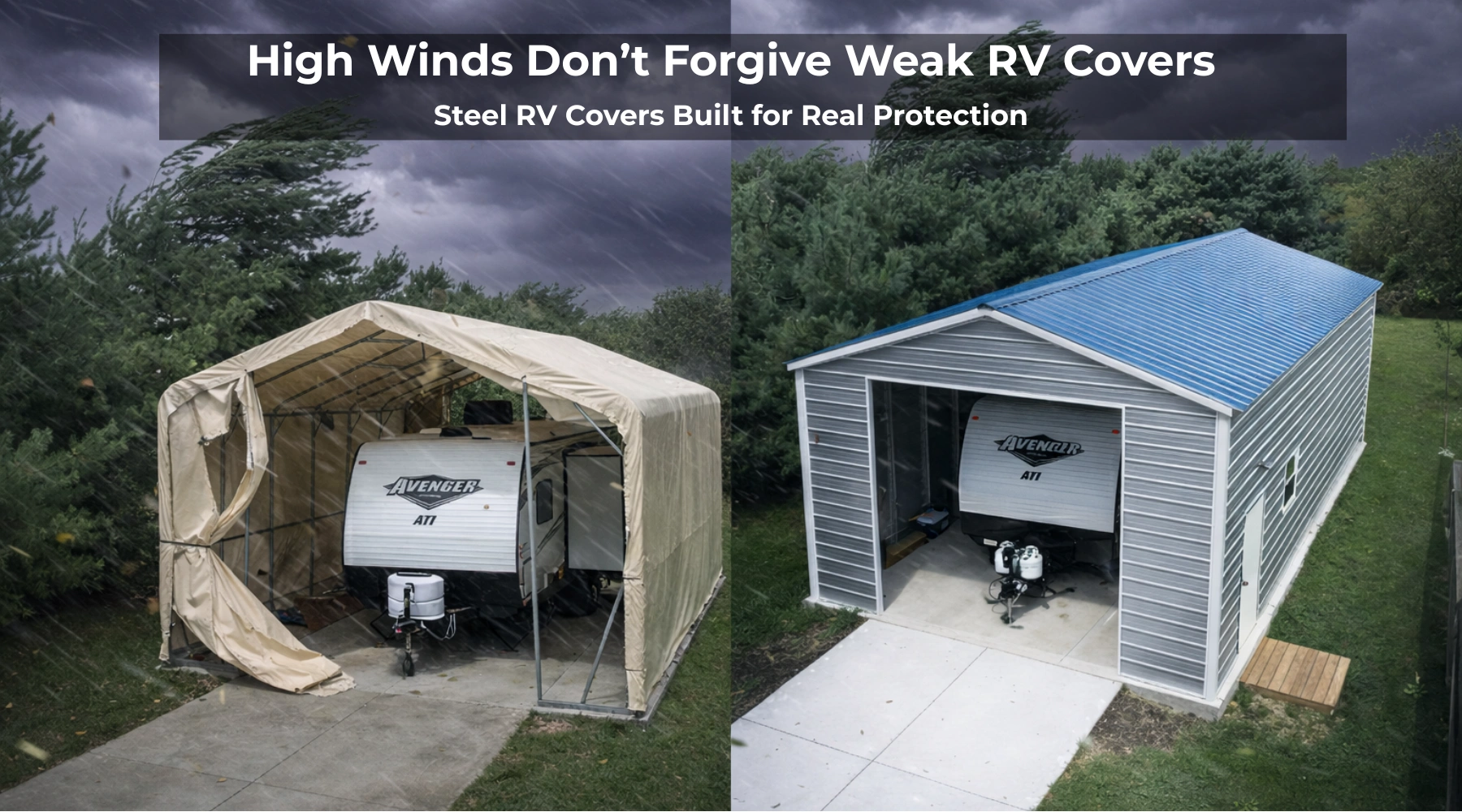
Owning an RV lets you enjoy the freedom, but with responsibility. A Class A motorhome can easily cost $100,000 to $300,000. But many RV owners try to protect it with basic fabric covers or lightweight structures. That’s risky and irresponsible, sorry to be harsh.
It is especially true if you live in states like Alaska, Kansas, Texas, or Oklahoma, where wind speeds can become dangerous within minutes. High winds don’t just push against your RV. They create uplift pressure, sideways force, and structural stress. If your RV cover isn’t engineered correctly, it can fail fast. We have talked about which RV cover designs and materials are best for these high wind zones in the USA. You can explore all the details, learn about metal RV covers, and make the right decision without making mistakes.
Why High-Wind Zones Demand More Than Regular RV Covers
Not all areas in the U.S. face the same wind risk. Some regions deal with hurricanes. Others face mountain gusts or tornado systems. That’s why buying any random RV cover can be a big mistake. Thus, before choosing a structure, you need to understand why wind zones change everything, from frame thickness to roof design.
Understanding Wind Risk in the U.S.
The U.S. follows wind load guidelines under the International Building Code (IBC) and ASCE wind maps. Here’s what that means in simple words:
- Inland states: 90–115 mph wind exposure
- Coastal Alabama & Arkansas storm areas: 120–140 mph
- Florida hurricane zones: 150–180 mph gust potential
- Colorado mountain areas: 110–130 mph gusts
For example:
- Metal RV covers in Alabama often need higher wind certification near coastal areas.
- Steel RV covers in Arkansas must handle storm systems and tornado activity.
- If you live in Colorado, the RV parking structure or carport must resist uplift caused by open terrain and elevation.
- Moreover, steel RV carports in Florida require hurricane-rated engineering. This is why wind rating is not optional. It’s critical.
RV Covers Pros and Cons (Fabric vs Metal)
Sometimes, you’re stuck in a deep thought about whether fabric is good or if you should go with metal structures. Let’s help you clear the confusion.
1. Regular RV Covers (Fabric)
Pros:
- Low upfront cost
- Easy to install
- Lightweight
Cons:
- Tear easily in high wind
- Short lifespan (2–5 years)
- No structural resistance
- Can flap and scratch RV paint
2. RV Covers (Steel)
Pros:
- Wind-rated options available
- 20–30+ year lifespan
- Strong anchoring systems
- Snow + wind resistance
- Increases property value
Cons:
- Higher upfront investment
- Requires professional installation
If you live in a high-wind state, metal is not a luxury; it’s a safety measure. Now that we understand why metal is better, let’s talk about why it’s better.
What Wind Speed Can a Steel RV Cover Actually Withstand?
Many buyers assume all prefabricated covers are the same. They’re not. The real strength depends on certification, steel thickness, anchoring, and design.
1. Verified Wind Ratings in the U.S.
Most standard metal RV carports or covers are rated for:
- 90 mph (basic models)
- 110–140 mph (reinforced models)
- 170–180 mph (engineered hurricane-rated structures)
Certified engineered structures follow IBC and ASCE standards. Non-certified units may not survive strong storms. In hurricane-prone Florida, many engineered steel covers are designed to withstand wind loads of 150+ mph when properly anchored. This makes a huge difference in safety.
2. How Long Do Metal RV Covers Last?
A properly installed galvanized steel RV cover can last 20 to 30 years and even more if you maintain the space properly. This way, an RV cover can have a lifespan of 50 years or more. Compared to traditional RV covers, which may need replacement every few years, steel is a long-term investment.
But strength doesn’t depend only on wind rating. It also depends on the steel gauge.
Steel Frame Thickness – What Gauge Works for Each Wind Zone?
When buyers ask, “What is the best material for RV covers?” they often forget to ask about steel thickness. The steel gauge determines strength, so you should not take it lightly.
Lower number = thicker steel.
- 14-gauge frame → Strong residential strength
- 12-gauge frame → Heavy-duty commercial strength
- 29-gauge panels → Standard roofing
- 26-gauge panels → Thicker and stronger
Which Steel Gauge is Best for Which Wind Zone?
Don’t get confused by looking at the above steel gauges. You can easily decide which one is best for your RV protection by reading below.
Here’s a practical breakdown as per wind zones:
Mild Wind Areas (90–100 mph):
- 14-gauge frame
- 29-gauge panels
Moderate Wind Areas (110–130 mph):
- 14-gauge frame
- 26-gauge roof panels
- Reinforced bracing
High Wind / Hurricane Zones (150+ mph like Florida):
- 12-gauge frame
- 26-gauge panels
- Concrete anchors
- Additional bracing
If you are investing in a large structure like a 20x35x12 metal RV carport, upgrading the gauge is smart. But frame thickness alone isn’t enough. Design matters even more.
Design Features That Actually Protect Your RV From Wind
Many buyers focus only on size. That’s a mistake. Wind resistance depends heavily on design features as well. If you know some key features and designs, it becomes easy to choose the best steel parking structure for your RV.
1. Vertical Roof vs Regular Roof
If you compare the vertical roof with the regular roof style of an RV carport. A vertical roof is the strongest option. Because its panels run from ridge to eave, wind flows over more smoothly, reducing uplift pressure, and the roof design is also better for snow drainage. So, if you are considering a 20x21x7 vertical roof metal carport, this style is ideal for windy regions. Regular roofs cost less but are less stable in high wind zones.
2. Reinforced Anchoring System
A strong frame without proper anchoring can still fail. That’s why anchors are critical to a structure’s strength, enabling it to withstand strong winds and tornadoes.
Key types of anchors:
- Ground anchors (for soil installation)
- Concrete wedge anchors
- Mobile home anchors (stronger hold in hurricane zones)
3. Enclosed vs Open Metal RV Covers
Fully enclosed steel covers perform better in extreme wind conditions. These steel buildings feature side panels that block the sideways wind force. It reduces internal wind pressure and offers stronger structural stability. This is especially useful in Metal RV covers in Colorado, where wind gusts can hit sideways from open plains.
4. Metal RV Cover with Storage
Adding storage walls strengthens the structure and offers more stability. You can keep tools and other equipment in a steel RV cover with storage to easily access them and repair your vehicle. So, a prefab carport is more than a parking space, providing additional wind-blocking in high-wind zones.
5. Metal RV Cover with Lean-To
A prefab RV cover with a lean-to extension is also a widely used type of RV cover. Here is what it offers to an RV owner.
- Extra covered area
- Additional structural balance
- Protection for boats, ATVs, or cars
Popular Metal RV Cover Sizes and Their Wind Performance
The size of a metal building affects stability. Taller and wider structures experience more wind pressure. Knowing some sizes and understanding their importance will make building installation easy for you.
1. 20x21x7 Vertical Roof Metal Carport
With a vertical roof and the best steel gauge frame, it can perform well up to 110-130 mph.
Best for:
- Small to mid-size RVs
- Moderate wind areas
2. 20x35x12 Metal RV Carport
Best for:
- Class A motorhomes
- Large fifth wheels
Because of height (12 ft), upgrading to 12-gauge steel is recommended in high-wind zones.
3. Metal RV Awning vs Full RV Cover
A metal RV awning provides sun protection and light rain coverage. But it does not offer full wind protection. A complete steel structure is safer for storm-prone regions. Next, let’s answer the most common buyer question.
Metal RV Carport Prices – What Affects the Cost?
When you choose a metal RV carport, price is one of the most important things to consider. However, it is not fixed; several factors affect the cost of an RV cover.
Prices vary based on:
- Steel gauge (12-gauge costs more than 14-gauge)
- Roof type (vertical roof costs more but performs better)
- Wind certification
- Enclosed panels
- Size
Basic structures like regular roof metal carports may start at around at $1,295. Upgraded hurricane-rated structures cost more, but they protect a six-figure RV. Location matters too. But, before buying, there’s one more important step: finding a reliable metal building dealer.
Buying Guide – Before You Search “Metal RV Covers for Sale Near Me”
Before you start searching for a reliable steel building dealer, know everything about your needs. The best way to find it is through asking some questions.
- What is your wind zone rating?
- Do you need 12 or 14-gauge steel?
- Vertical roof or regular roof?
- Concrete foundation ready?
- Wind certification required?
- Warranty included?
Here is one more thing before you make a decision: do not buy only based on price, buy based on wind safety because RV covers in high-wind zones must be strong.
Final Thought: Don’t Risk a $100,000 RV on a Weak Structure
High winds don’t give warnings. A weak structure can fail in minutes. If you live in Florida, Arkansas, or any state or county, investing in engineered RV covers made of steel frames is not optional; it’s protection. So, if you’re spending thousands on an RV, don’t cut corners on the cover. Choose a custom RV carport or cover by contacting experts at (336)-914-1654. This way, you will get an upgraded structure constructed with the best steel gauge. Moreover, we offer metal buildings of all types, like garages, barns, and sheds, with a certified wind rating. Because repairing storm damage costs far more than building it right the first time.
 (336)-914-1654