- April 21, 2026
- Metal Carports
- Carports Advisor
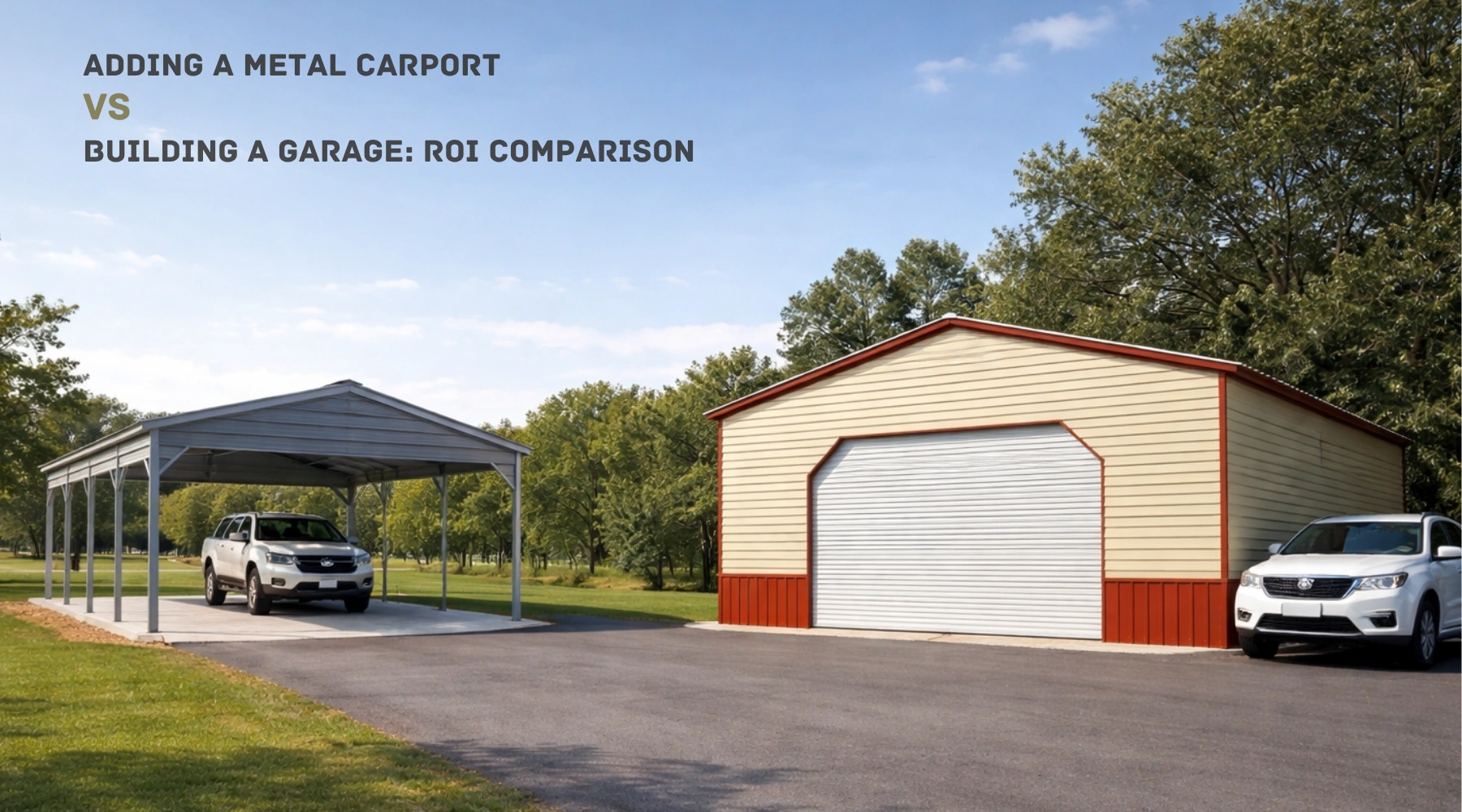
Adding A Metal Carport vs Building A Garage: ROI Comparison
You need covered parking. Maybe you’ve got a vehicle sitting in the driveway, equipment exposed to the elements, or just need more functional space on your property. The big question is: do you go with a metal carport, fast, affordable, and practical, or do you commit to a full metal garage build? Both are solid choices. But which one actually gives you more bang for your buck?
That’s exactly what this blog breaks down. We’re going beyond the sticker price and looking at real ROI, what you spend, what you gain, and what your property is actually worth afterward. Whether you’re a homeowner, investor, or farmer, the numbers here will help you make a smarter call.
Let’s start from the beginning. What are you actually buying?
First, Know What You’re Buying: Structures & Styles Explained
The Metal Carport: More Options Than You Think:
A prefab carport is one of the most accessible parking solutions on the market today.
- Regular roof metal carport — This is the classic, budget-friendly option. The panels run horizontally, making it the most affordable build. It works well in mild climates where heavy snow or constant rain isn’t a concern. Great for basic vehicle protection without overcomplicating things.
- Vertical roof metal carports — These are the premium tier of the carport world. The roof panels run vertically along the ridge, which means rain, snow, and debris slide right off instead of pooling. They hold up better against harsh weather and last longer with less maintenance.
Size plays a big role too — here’s how the options stack up in real life:
- One car carport — Compact and budget-friendly. Perfect for a single vehicle, a motorcycle, or small equipment storage. Ideal for tight lots or secondary coverage needs.
- Two car carport — The most popular choice for families. Covers two vehicles side by side and adds genuine utility without breaking the bank.
- Three car carport — Built for larger households, farms, or properties that need to shelter multiple vehicles, ATVs, or work equipment simultaneously.
Take a 30x65x12 metal utility carport as a real-world example. At 30 feet wide, 65 feet long, and 12 feet tall, this is a serious structure designed for serious use, think equipment storage on a farm, covered parking for multiple oversized vehicles, or a flexible outdoor workspace. The price tag is higher than a standard one-car unit, but so is the value it delivers.
The Metal Garage: Enclosed, Secure, Permanent
A metal garage takes everything a carport offers and wraps it in four walls with a lockable door. That means full weather protection.
- Regular roof metal garage — The entry-level enclosed option. Horizontal roof panels keep costs lower, but like the carport version, the regular roof metal garage is better suited for milder weather conditions.
- Vertical metal garage — Vertical roof panels combined with fully enclosed walls make this the most weather-resistant and longest-lasting option in the lineup. If you’re building in a region with heavy snow loads or frequent storms, a vertical metal garage is the configuration to go with.
Here’s how the size tiers work for garages:
- One car garage — Small footprint, relatively lower build cost, and surprisingly strong ROI for starter homes or properties in dense neighborhoods.
- Two car garage — The gold standard for homebuyers. More than any other feature, a two car garage consistently tops wish lists — and that buyer demand drives real resale value.
- Three car garage — Commands premium pricing in the right market. Adds significant square footage, visual presence, and serious appeal for high-value buyers or collectors.
For large-scale builds, look at something like a 40x80x14 steel garage with wrap around lean-to. This is a full-size steel building — 40 feet wide, 80 feet deep, 14-foot sidewalls — with a lean-to addition running along the side. That lean-to creates extra covered space for equipment, storage, or a covered work area.
What Does Each Structure Actually Cost?
Metal Carport & Steel Carport Cost Breakdown
One of the biggest advantages of a steel carport or prefab carport is price transparency. You know what you’re getting, and you know roughly what it’ll cost before anyone picks up a shovel — or in most cases, a wrench.
Standard pricing ranges look like this:
- One car carport (regular roof): $1,500 – $2,500
- Two car carport (vertical roof): $3,500 – $6,000
- Larger utility carports (30×65 and similar): $7,000 – $12,000+
A prefab carport ships with pre-cut components, which significantly reduces labor time. Most installations are completed in one to two days. No foundation is needed in most cases — just a gravel base or concrete anchors, depending on your local soil and wind conditions. Permits are rarely required, though it’s always worth a quick check with your local municipality.
The gap between a regular roof metal carport and a vertical roof metal carport in cost is typically $500–$1,500, depending on size. That difference is usually worth it given the extended lifespan and reduced maintenance.
Metal Garage & Metal Buildings Cost Breakdown
Building a metal garage is a fundamentally different financial commitment. You’re not just paying for the steel structure — you’re paying for a foundation, potential permits, insulation, electrical rough-in, and finishing details like doors, windows, and interior walls.
Here’s a realistic breakdown of what drives the cost:
- Foundation (concrete slab): $4 – $8 per square foot — a 20×20 slab runs $1,600–$3,200 on its own
- Structure and materials: $6,000 – $30,000+ depending on size, roof style, and specs
- Permits and inspections: $500 – $2,000 depending on jurisdiction
- Doors, windows, insulation: $1,000 – $5,000 depending on finish level
For metal buildings at the larger end — like the 40x80x14 steel garage, total project costs can comfortably exceed $50,000 once site prep, foundation, and finishing are factored in. But the structure itself is engineered to last 40–50 years with proper maintenance, which completely changes the ROI math over a long horizon.
Side-by-Side Cost Comparison Table:
| Structure | Example Size | Roof Style | Est. Cost | Install Time |
| One Car Carport | 12×20 | Regular Roof | $1,500 – $2,500 | 1 Day |
| Two Car Carport | 20×20 | Vertical Roof | $3,500 – $6,000 | 1–2 Days |
| Three Car Carport | 30×30 | Vertical Roof | $5,500 – $9,000 | 2 Days |
| 30x65x12 Metal Utility Carport | 30×65 | Vertical Roof | $7,000 – $12,000 | 2–3 Days |
| One Car Garage | 12×20 | Regular Roof | $8,000 – $15,000 | 1–2 Weeks |
| Two Car Garage | 20×20 | Vertical Roof | $18,000 – $30,000 | 2–4 Weeks |
| Three Car Garage | 30×30 | Vertical Roof | $28,000 – $45,000 | 3–5 Weeks |
| 40x80x14 Steel Garage w/ Lean-To | 40×80 | Vertical Roof | $35,000 – $55,000 | 4–6 Weeks |
ROI Breakdown: Which Structure Puts More Money Back in Your Pocket?
How ROI Is Measured for Home Additions:
Return on investment for a home improvement is calculated like this:
ROI = (Value Added − Cost of Project) ÷ Cost of Project × 100
But the number that comes out of that formula isn’t set in stone. ROI on carports and garages shifts significantly depending on:
- Location — Rural markets respond differently from dense suburban neighborhoods
- Home value — A garage addition on a $150K home hits differently than on a $500K home
- Buyer demand — In markets where garages are expected, not having one can actually hurt your sale price
- Roof style and build quality — A vertical roof structure holds its value better than a regular roof over time
With that framework in mind, let’s look at how each structure actually performs.
ROI of A Metal Carport: Fast, Affordable, Surprisingly Strong
A well-chosen metal carport delivers a solid ROI — especially when you consider the low upfront investment. On average, homeowners see returns in the 50–70% range, with vertical roof metal carports consistently outperforming regular roof metal carport builds because of their durability and visual appeal.
Here’s a real-world example to put it in perspective:
Example: A two car carport installed for $5,500 in a mid-market suburban area adds approximately $3,000–$3,800 in perceived property value. That’s an ROI of roughly 55–69%, not bad for a structure that went up in two days.
Metal carports perform best as ROI investments in these situations:
- Rental or investment properties where covered parking justifies higher monthly rents
- Rural and semi-rural areas where covered equipment storage is a genuine need
- Homes in mild climates where a fully enclosed garage isn’t a buyer priority
- Budget-conscious homeowners who want to add functional value without a large commitment.
ROI of A Metal Garage: Bigger Investment, Bigger Ceiling
A metal garage carries a higher upfront cost, but it also carries a higher value ceiling. Attached garages consistently outperform detached builds, with average ROI ranging from 64% to 80% in competitive suburban markets.
An upgrade from a steel carport to an enclosed metal garage changes how buyers perceive the property entirely. Where a carport says ‘convenient,’ a garage says ‘complete.’ That shift in buyer psychology translates to real numbers.
Here’s a real-world example:
Example: A two car garage built for $27,000 in a family-oriented suburb adds approximately $18,000–$22,000 in appraised value. That’s an ROI of 67–81% — and in hot markets, it can push even higher because a garage is often a deal-maker or deal-breaker for buyers.
Metal garages deliver their strongest ROI in these scenarios:
- Suburban homes where a two or three car garage is expected by the buyer pool
- Cold-climate regions where enclosed vehicle storage isn’t optional — it’s essential
- Long-term homeowners who plan to stay 10+ years and recoup value gradually
- Large properties where a full metal building like a 40x80x14 steel garage with wrap around lean-to serves both residential and commercial needs
ROI Comparison Table (By Structure & Size):
| Structure | Investment | Est. Value Added | ROI % | Best For |
| One Car Carport (Regular Roof) | $2,000 | $1,100 | ~55% | Budget buyers, mild climates |
| Two Car Carport (Vertical Roof) | $5,500 | $3,500 | ~64% | Families, rental properties |
| Three Car Carport (Vertical Roof) | $8,000 | $5,200 | ~65% | Large households, equipment |
| 30x65x12 Metal Utility Carport | $10,000 | $6,500 | ~65% | Farms, commercial, storage |
| One Car Garage (Regular Roof) | $12,000 | $8,000 | ~67% | Starter homes |
| Two Car Garage (Vertical Roof) | $27,000 | $20,000 | ~74% | Suburban family homes |
| Three Car Garage (Vertical Roof) | $38,000 | $28,500 | ~75% | Premium suburban, collectors |
| 40x80x14 Steel Garage w/ Lean-To | $45,000 | $32,000 | ~71% | Ranches, commercial, workshops |
The table tells one part of the story. But there are hidden ROI factors that most homeowners never think about — and they can swing the numbers significantly.
The Hidden ROI Factors Nobody Talks About
1. Maintenance Costs Over 10 Years
One area where metal carports and prefab carports quietly outperform larger builds is in ongoing maintenance. Because there are no enclosed walls, no doors, no roof drainage systems, and no electrical components, upkeep is nearly non-existent.
Here’s how the 10-year maintenance cost comparison breaks down:
- Steel carport / Prefab carport — Estimated $200–$500 over 10 years. Occasional bolt tightening, a coat of rust-inhibiting paint, and you’re done.
- Metal garage / Metal buildings — Estimated $1,500–$5,000 over 10 years. Garage doors require maintenance, weatherstripping needs replacing, roofing seams may need resealing, and any insulation or HVAC additions add to the upkeep tab.
That $1,000–$4,500 difference in maintenance costs effectively reduces the net ROI of a garage over time — worth factoring into your calculations.
2. Speed of Return — When Does Each Break Even?
A metal carport or steel carport essentially breaks even from day one. The cost is low, the utility is immediate, and if you’re renting a property, the covered parking can add $50–$150/month in rental value — meaning the structure pays for itself in under three years in many cases.
A metal garage takes longer to break even, but the ceiling is higher. In a hot real estate market, a two car garage can add more to your sale price than the entire cost of the build. The risk is that in slower markets, or if you sell before the property appreciates, you may recover less than expected.
Bottom line: carports are low-risk, fast-return investments. Garages are higher-risk, higher-ceiling investments.
3. Property Tax & Insurance Impact
Here’s something most homeowners overlook: a fully enclosed metal garage is often assessed as a permanent structure, which means it can raise your property’s taxable value. Depending on your county’s assessment rate, a $30,000 garage could add $200–$600 per year to your property tax bill.
A metal carport, especially a prefab carport that isn’t anchored to a permanent foundation, typically flies under the radar in most jurisdictions and doesn’t trigger a reassessment. That said, rules vary by location, so a quick call to your local assessor’s office is always smart.
On the insurance side, enclosed metal buildings like garages may increase your homeowner’s insurance premium slightly (because there’s more insured value), but they can also reduce vehicle insurance costs if your insurer recognizes that enclosed storage reduces the risk of weather damage and theft.
So Which One Should You Choose?
Choose a Metal Carport If…
- A metal carport is the smarter financial move in these situations:
- Your budget is under $10,000, and you need maximum coverage per dollar.
- You need protection fast; a prefab carport goes up in one to two days with minimal disruption.
- Your property is rural, agricultural, or used as a rental, where carports add functional value without over-improving
- A one car carport or two car carport covers your current parking needs without excess.
- You want flexibility; most carport structures can be relocated, expanded, or reconfigured later.
- Your local climate is mild, and fully enclosed storage isn’t a buyer expectation in your market.
Choose a Metal Garage If…
A metal garage makes more financial sense when:
- You’re in a high-demand suburban or urban market where a garage is expected — not optional
- Your climate includes heavy snow, ice, or regular storms that demand fully enclosed vehicle protection
- You want a two car garage or three car garage to maximize buyer appeal at resale
- You’re planning a large-scale, multi-purpose build — like a 40x80x14 steel garage with wrap-around lean-to — that serves both residential and commercial uses
- You’re a long-term homeowner on a 10+ year horizon, giving the investment time to fully appreciate
- You want the added benefits of enclosed storage, workshop space, or a home-based business setup
The Bottom Line
If you’ve made it this far, you already know there’s no single right answer. Both metal carports and metal garages deliver real, measurable ROI — the difference is in how quickly, how much, and under what conditions.
Metal carports win on speed, affordability, and flexibility. They’re low-risk investments that add immediate utility and consistent value. For rental properties, agricultural use, or budget-conscious homeowners, a prefab carport or steel carport is hard to beat.
Metal garages win on perceived value, buyer appeal, and long-term ceiling. In the right market, they’re the kind of addition that justifies a higher listing price and faster sale. For suburban homeowners, cold-climate regions, or anyone building at scale with metal buildings, the ROI case is strong.
Before you decide, ask yourself these three questions:
- What does my local real estate market actually value — covered parking or enclosed garages?
- What’s my timeline? Am I selling in two years or staying for ten?
- What’s my budget, and how much risk am I comfortable taking on this improvement?
Your answers will point you in the right direction faster than any general recommendation can.
 (336)-914-1654